Intra-oral swellings and abnormal appearance
Brief description of the condition
Swellings in the oral cavity can vary in speed of onset, position and extent/size. Small lumps are common and are almost always benign, especially in patients under 50 years of age. Angioedema is an uncommon rapid onset diffuse swelling that can affect the face and mouth and may be the result of an allergic reaction (see Angioedema).
Red, white, or mixed speckled red and white patches or pigmented areas can develop in the oral cavity, varying in size, position and extent. See also Oral ulceration.
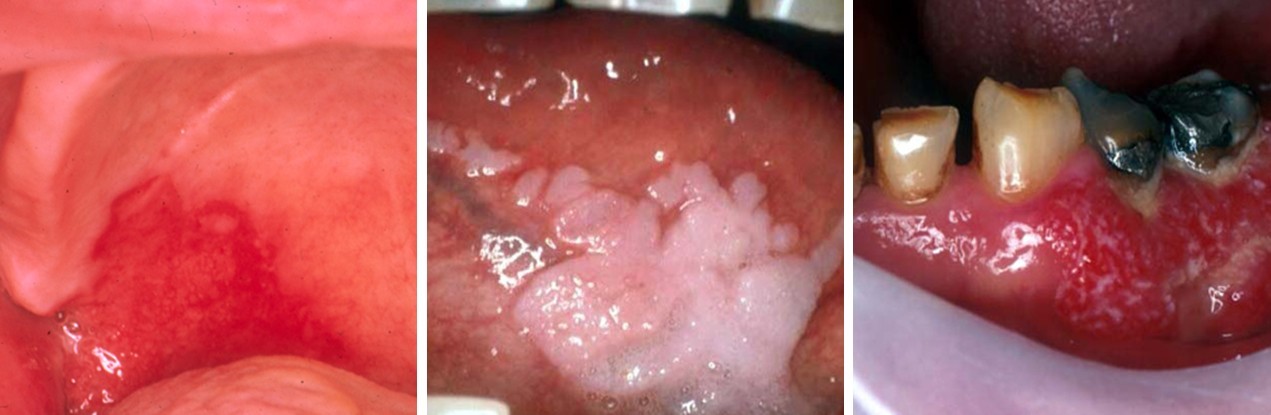
Red patch (left); white patch (middle); speckled patch (right)
Illustrations: NHS Education for Scotland
Key signs and symptoms
- A firm or soft lump
- Swelling may be static or increase over hours
- Swelling due to sepsis or oedema around or in the tongue or pharynx
- Ulcerated swelling
- A change in normal appearance to a red, white, or mixed red and white patch
- A pigmented area on the soft tissues or tongue (e.g. black/grey/blue)
Initial management
Determine if the airway is compromised. Symptoms include: difficulty breathing; high pitched breathing sound (stridor); difficulty swallowing (dysphagia); hoarse or muffled sounding voice (dysphonia).
If the airway is compromised, send the patient immediately to emergency medical care at the nearest emergency department or call 999.
If the airway is not compromised:
- Determine how long the altered appearance has been present.
- If a red, white or mixed speckled red and white patch or a pigmented area has been present for 3 weeks or more, refer the patient via the local Urgent Suspicion of Cancer (USC) referral pathway (oral and maxillofacial surgery) to investigate potential dysplasia or malignancy.*37 Healthcare professionals who are unable to make an Urgent Suspicion of Cancer referral should direct patients to a dental or medical healthcare professional who can.
- If a red, white or mixed speckled red and white patch or a pigmented area has been present for less than 3 weeks, advise the patient to seek non-urgent dental care (i.e. within 7 days) for assessment.
- If a lump or swelling is ulcerated or has begun to increase in size rapidly, advise the patient to seek urgent care.
Subsequent care
Monitor symptoms at follow-up appointments.
Record altered appearance with a smartphone or digital camera.
Consider referral to an oral and maxillofacial surgeon or an oral medicine specialist.
For red and white patches and pigmented areas, if the lesion does not resolve in 3 weeks, refer the patient via the local Urgent Suspicion of Cancer (USC) referral pathway to investigate potential dysplasia or malignancy.*37